Imogen Hill Art
Additional Content
POSTGRADUATE FINE ART SHOW

I had my mixed media painting, Study of a Wildlife Garden and concertina, Taking Myself For a Walk on display at the degree show. During curation myself, tutors and other students exhibiting moved our artworks around constantly to see how each work communicated with each other while also being conscious of each other's preferences of how they envisioned their work to be displayed. I really enjoyed the discussions that we had as our works dealt with similar themes of landscape, natural forms and technology, while also differenciating from each other in style and medium. Once we were all happy with the placement of our artworks I considered how I would want my works to be displayed in their allocated spaces. Previously I imagined the concertina to be on the floor for people to pick up and look through, but I recieved suggestions from Gavin and Geraint about displaying it higher, perhaps on a shelf. I ended up deciding to nail the concertina directly to the wall in a zig zag effect, travelling horizontally from one wall to another where it creeps directly under Study of a Wildlife Garden. I decided on nailing the concertina at a similar height to the bottom Xuan's painting so that the artworks would flow and take the audience's eyes on a journey around the room, however, I think that the concertina was too low to closely look it as they are small designs. I also made 80 handmade business cards from ink and watercolour based on natural forms in Sydenham Garden that feature in Study of a Wildlife Garden.


Cyanotypes in the neighbouring room from mine at the degree show. I saw these and remembered seeing this photography process in Unearthed: Photography's Roots, a past exhibtion at Dulwich Picture Gallery. Annoyingly I didn't take a photo of the photography student's name, but I really liked these photographs / the Cyanotype process.
HAMPTON COURT FLOWER SHOW

On a whim I got a ticket to Hampton Court flower show as my family had a spare ticket. This was before I started developing any Cyanotypes but after I had seen the Cyanotypes at the degree show so I jumped at the opportunity to go to see some gardens that had been designed by people who specialise in gardening / garden design. There were lots of wildlife gardens, natural forms composed in an organised way that reminded me of the placement of plants in Cyanotypes by Anna Atkins, so alot of the photography I took from that day are of leaves at angles that I thought were effective and would end up placing them in the same way in my own Cyanotypes.

KNOLE
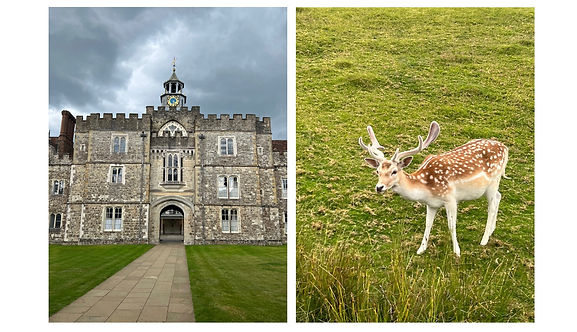

I visited Knole in July, my other grandad does volunteering there looking after the deer and sometimes I go to see him there. On this particular visit I found out that there was a limited time exhibition on the life of Vita Sackville-West which meant that the original manuscript of Orlando by Virginia Woolf was on display there (as the book is inpired by Vita and gifted to her by Woolf in 1928), which I had to see because Orlando is one of my favourite novels and due to its fragility as the ink used by Woolf is sensitive to light so it is rarely on display.
I also took a guided tour around the gardens, where the tour guide led myself and others to the oak tree that Woolf would spend alot of time with and inspired the famous, reflective poem that Orlando writes for almost three hundred years (photographed below). Oak trees are a symbol of strength and Woolf perhaps found comfort in being close to it. Nature also reminds us of memories so being in the presence of it might have also reminded her of being with / close to Vita while not being with her in the flesh.

BRONTE PARSONAGE MUSEUM / HAWORTH MOOR

While staying in Yorkshire I travelled to Haworth to see the Brontë Parsonage Museum. Due to being aware of their writing being inspired by their surroundings that iclude very late examples of nature's vital role in Romanticism as well as the supernatural, I thought it'd be fitting to experience the place for myself as well as being a fan of the sister's writing, especially of Emily and Charlotte's novels. I wasn't aware that their walks around Haworth had been mapped / recorded for people to experience for themselves which was a pleasant surprise. I retraced Emily Brontë's walking route around Haworth Moor, the moor that is described in Wuthering Heights that symbolise the wildness and freedom of Heathcliff and Cathy's at the beginning (photo of Haworth Moor at the bottom of this section). I thought it was important to experience exactly experienced to really understand how the location would have influenced her, by feeling the strong gusts of wind due to how flat the Moor is, I could picture her vision of Heathcliff and Cathy running around the moors as children on a wuthering day, and felt that I had a unity with her through the powerful force of nature.


HOME OF CHARLES DARWIN - DOWN HOUSE

In September I went to the home of Charles Darwin, who argued that evolution is natural selection, without any intervention from humans, suggesting that every life form started with nature and emphasises the omnipotence of nature. Darwin was also a botanist, he mainly worked with orchids and gathered evidence from them to support his theory of evolution through natural selection by proving that the release of spring-loaded pollen is caused by insect's proboscis touching an orchid to pollinate, further proving nature's relentlessness to spread and create more of itself. Nature is the start and cause of our existence.
Darwin's hothouse was my favourite area to walk through (photographs below). It was built in 1862 for experimental purposes. Darwin used his neighbour, George Henry Turnbull's hothouses to experiment on orchids and while he was writing Origin, and decided then that it would be useful to have his own. In the houthouse there was an endless amount of tropical plants and the shapes and textures of the leaves made me thin about how interesting Cyanotypes of them would be, so I photographed them in a similar way to when I photographed leaves at Hampton Court Flower Show in the style of a Cyanotype in case I decide to try out the process again with more textured or raggedy edged leaves.
